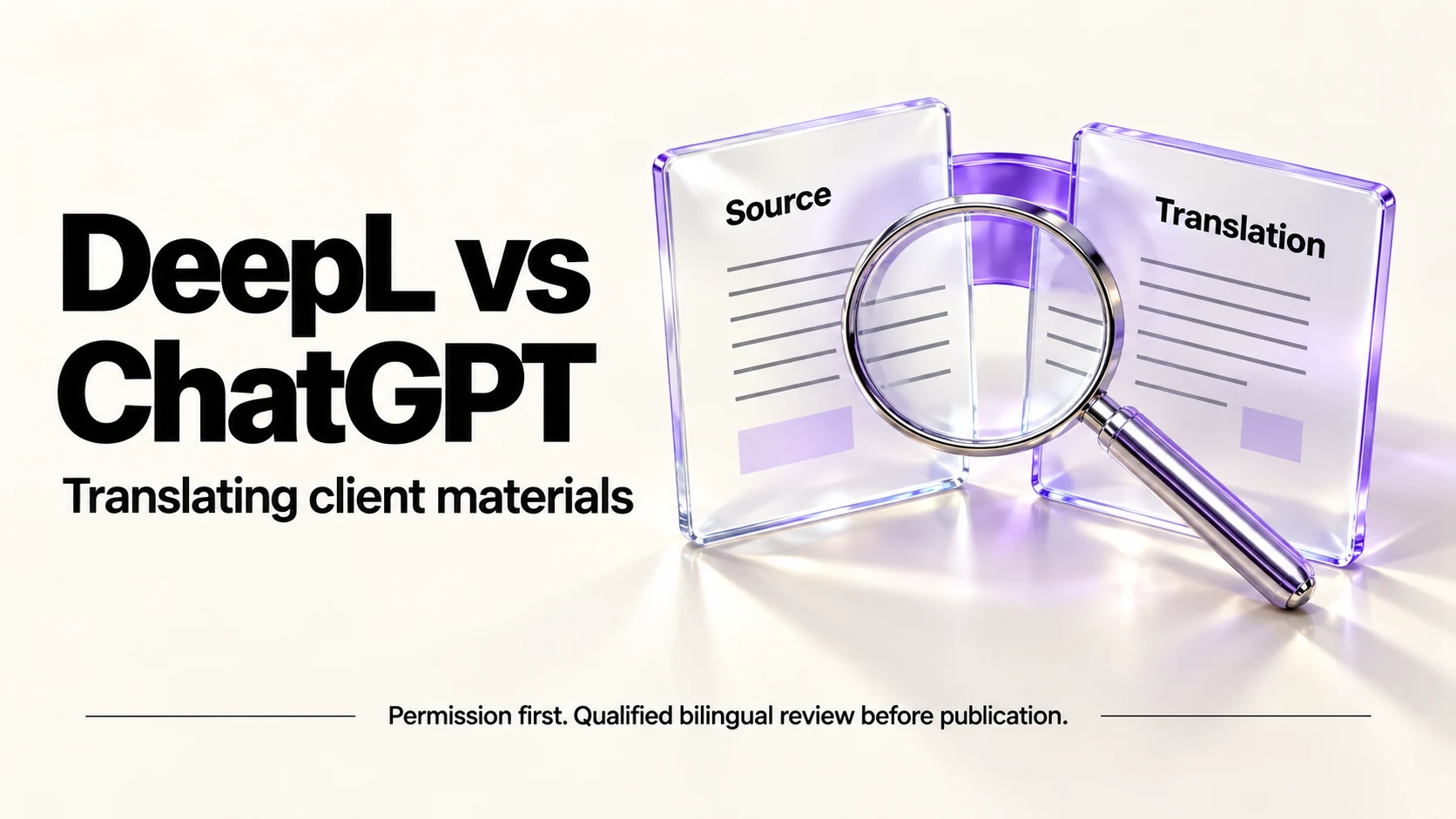
Consider DeepL Pro for permitted client documents and ChatGPT for permitted context-dependent copy. The deciding factor is not quality but terms: DeepL’s privacy policy says free-version texts are processed to train its networks and its terms forbid entering personal data, while Pro texts are deleted after translation and not used to improve the service. Whichever you use, have a qualified bilingual reviewer compare anything the client will publish against its source.
Original research dated September 20, 2026. Text revised September 21, 2026; Sources and method identifies the specific claims rechecked and any earlier observations retained. This article contains no affiliate links.
Who this is for
You work with clients in another language: incoming briefs you must understand exactly, and outgoing material that has to read naturally to a native speaker.
 Before you buyChatGPT Plus vs Claude Pro vs Google AI ProWhich AI subscription to pay for: plans, data settings and a five-step choice.See the plans →
Manual baseline: what you do now
Manual options include checking the original with a bilingual colleague or commissioning a translator. Speed and accuracy depend on the material and reviewer. The proposed workflow here combines a machine draft, terminology guidance and qualified bilingual review; it does not establish a quality ranking.
The terms that decide it
DeepL distinguishes free from Pro processing. Its free-service terms prohibit submitting texts containing personal data, and the privacy policy describes using free text and translations for service improvement. Pro submitted text is retained only as needed for the translation and is not used to improve the service. For personal data, the user still needs a lawful basis and, where applicable, a data-processing agreement. Source: DeepL privacy policy, sections 3 and 4
For ChatGPT, OpenAI documents a “Improve the model for everyone” setting under Settings, then Data Controls; with it off, conversations stay in your history but are not used for training. Temporary Chats are deleted after 30 days, are not used to train models, and “may be reviewed only to monitor for abuse”. Source: OpenAI Data Controls FAQ
The practical reading: do not put personal data in DeepL Free. For either paid DeepL or ChatGPT, check client authorization and applicable processing terms before sharing confidential material. ChatGPT’s training toggle does not remove retention or safety review, and is not a DeepL Free opt-out.
What DeepL costs
| Plan | Price | Characters a month | File translations | Glossaries |
|---|---|---|---|---|
| Free | €0 | 50,000 | 1 a month | 1 glossary, 5 entries per language pair |
| Individual | €7.49 a month billed yearly | 300,000 | 3 a month | 1 glossary, 5 entries |
| Team | €24.99 per user a month billed yearly | 1,000,000 | 20 a month | 5 glossaries, 1,000 entries |
| Business | €49.99 per user a month billed yearly | Unlimited | 100 a month | Unlimited |
Source: DeepL Pro pricing. Note the glossary limits: on the individual plan, 5 entries per language pair is enough for product names, not for a full terminology list. Compare the glossary allowance with the terminology list you actually need.
ChatGPT’s paid plans are priced separately and served in regional currency; our connection was shown yen, so check the page for your own country.
Which one for which job
| Job | Use | Why |
|---|---|---|
| Understanding a non-sensitive brief you may share | Either, within its permitted-use terms; set ChatGPT training preferences separately | Verify requirements against the original. DeepL Free has no opt-out that permits personal data |
| A client contract or document with personal data | Appropriately authorized DeepL Pro processing, or a qualified translator | DeepL Free is excluded for personal data; client permission and applicable processing agreements still matter |
| Marketing copy for another market | ChatGPT on permitted material, then qualified bilingual review | Copy needs adaptation, not literal translation |
| Repeated product terminology | DeepL with a glossary | Guides terminology; check the result against the glossary |
| Anything the client will publish | Machine draft plus a qualified bilingual reviewer | Errors are public and attributed to your client |
A five-step routine that catches errors
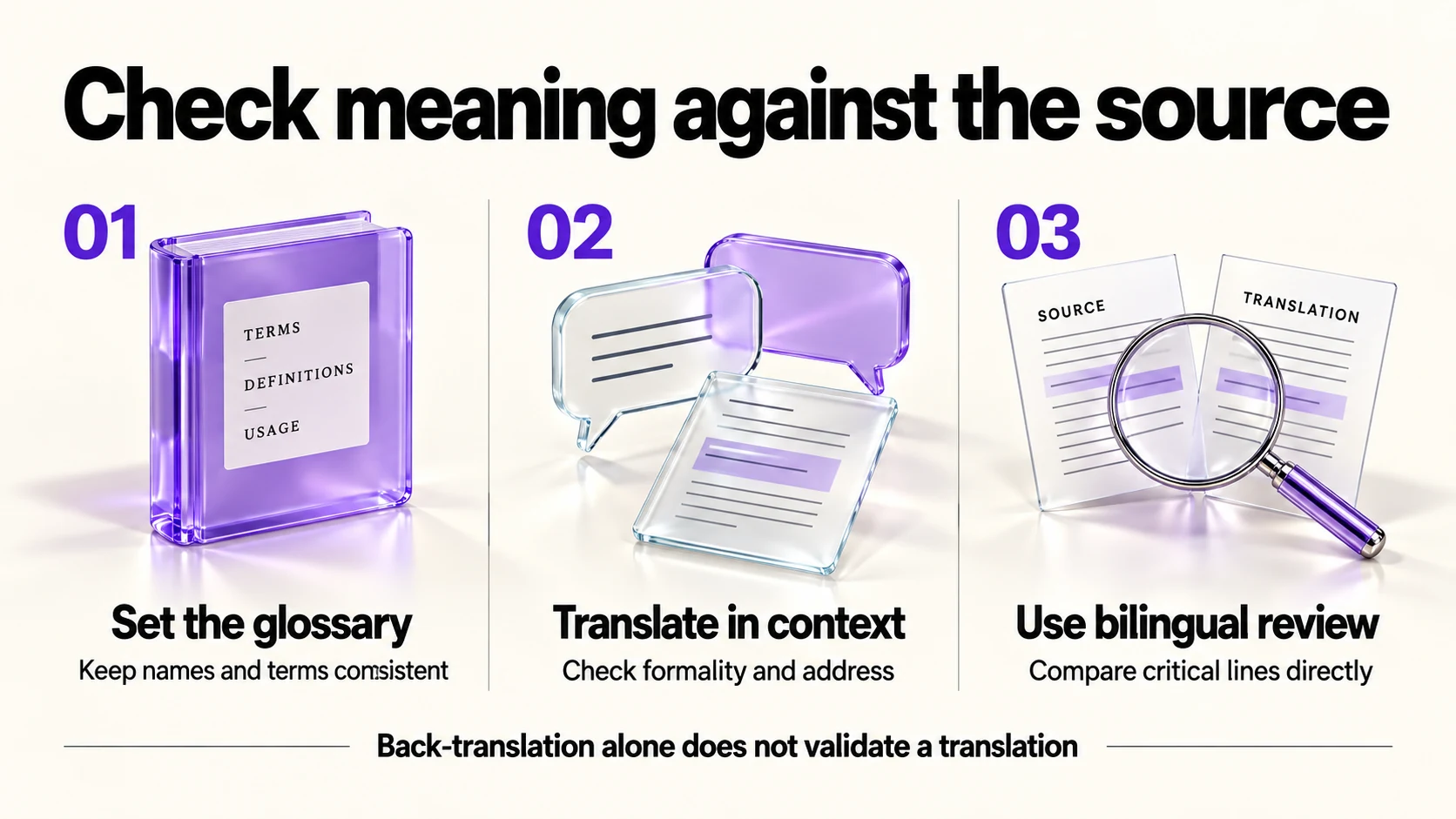
- Set the glossary first for product names, job titles and anything that must not be translated.
- Translate in context, whole sections rather than fragments, then check how the translation resolves pronouns and formality.
- Back-translate the critical lines. Use back-translation as an additional signal only; it can repeat the same mistake. Have a qualified bilingual reviewer compare prices, dates, legal sentences and calls to action directly with the source.
- Check formality and address. Many languages force a choice between formal and informal address; state which one you want before drafting.
- Have a qualified bilingual reviewer compare source and translation before publication. Budget this as part of the job, not as an optional extra.
Where machine translation still fails
- Humour, idiom and wordplay in marketing copy.
- Legal effect. A translated contract clause is not a substitute for a lawyer in the target jurisdiction.
- Regulated wording in health, finance and similar fields.
- Names and addresses, which can be reformatted or mangled.
- Tone across cultures, where a direct English sentence can read as rude, or an indirect one as evasive.
Frequently asked questions
Is DeepL’s free version safe for client work?
Its privacy policy says free-version content is processed to train its networks, and its terms forbid translating texts containing personal data. For client documents containing personal or confidential information, use an appropriately authorized service or qualified translator; Pro does not by itself establish client permission.
Does ChatGPT keep my translations?
OpenAI documents the training setting and says Temporary Chats are deleted after 30 days and are not used for training, though they may be reviewed to monitor for abuse.
Which is more accurate?
The documented difference is in terms and features, and that is what this article compares.
Do I still need a human translator?
We recommend a qualified bilingual reviewer for anything published in your client’s name, and an appropriate specialist for legal or regulated text. This is our editorial recommendation, not a tested industry standard.
Sources and method
Revised September 21, 2026 after rechecking DeepL’s linked privacy policy and OpenAI’s Data Controls FAQ. The table now distinguishes DeepL Free’s personal-data prohibition from ChatGPT’s training preference; Pro still requires appropriate authority for processing. DeepL prices and plan limits retain the original September 20 euro-page observation, not a USD checkout. The job table and bilingual review steps are suggestions; back-translation alone does not validate a translation.
Read next