Semrush’s SEO plan is US$139 a month, or $117.33 a month billed annually, for 5 websites and 500 keywords tracked daily. That annual display implies approximately $1,408 a year. Identify what free tools cannot answer, then pay only if the required features support work you will actually do. Otherwise start free and revisit in six months.
Original research dated September 21, 2026; text revised September 21, 2026. Claim-specific rechecks are identified in Sources and method. This article contains no affiliate links.
Who this is for
You run one website for your own business, you know SEO matters, and you cannot tell whether a US$139 monthly tool is an investment or a subscription you will forget to cancel.
What the plan includes
All prices below are in USD. Semrush’s terms, section 5.1 define website dollar amounts as US dollars unless stated otherwise; checkout may designate another currency.
| Plan | Monthly | Annual, per month | Websites | Keywords tracked daily |
|---|---|---|---|---|
| SEO | US$139 | $117.33 | 5 | 500 |
| Starter | $199 | $165.17 | 5 | 500 |
| Pro+ | $299 | $248.17 | 15 | 1,500 |
| Advanced | $549 | $455.67 | 40 | 5,000 |
Source: Semrush pricing. SEO includes basic AI reporting, but not a dedicated prompt-tracking quota, AI-ready Site Audit or per-domain AI brand performance. Starter adds those capabilities. The subscription guide resolves the broad marketing descriptions.
The yearly number, plainly
At the monthly rate, US$139 a month is $1,668 a year. At the annual rate of $117.33 a month, the rounded display implies $1,407.96, approximately $1,408 a year; confirm the actual annual invoice. For a one-person business, that is a real line item: roughly the cost of a small laptop, or several months of your accounting software. The question is not whether the tool is good. It is whether you will use $1,400 of it.
What you get free, and where it stops
- Google Search Console gives you your own impressions, clicks, positions and which pages earn them. Free, and it is your data rather than an estimate.
- Analytics tells you what people do after they arrive.
- Manual checks show you the actual results page for your main terms.
- Where a paid tool may add depth or scale: competitor keywords you do not already know, backlink data, historical rank tracking at scale, and site audits that catch technical problems you cannot see.
Start by seeing which questions the first three answer for your site. Free products can also provide limited backlink and audit information. The paid tier earns its place when you need the fourth group regularly.
Five questions before you subscribe
- Is search your main channel? If clients come from referrals and a network, a rank tracker will not change that.
- Will you act on research? New pages, revisions to existing pages and technical fixes can all be relevant; publishing twice monthly is not a proven threshold.
- Do you have 500 keywords worth tracking? Choose keywords based on your services and audience; page count alone cannot establish the number needed. That is not an argument for a bigger plan.
- Will you act on a site audit? A list of 300 technical issues is useless if nobody fixes them.
- Can you cancel in three months without losing work? Paid subscribers should export needed data within their plan limits before access ends. Data exports are disabled during trial subscriptions; do not plan on a trial export. See Semrush’s subscription guidance, checked September 21, 2026.
A cheaper middle path
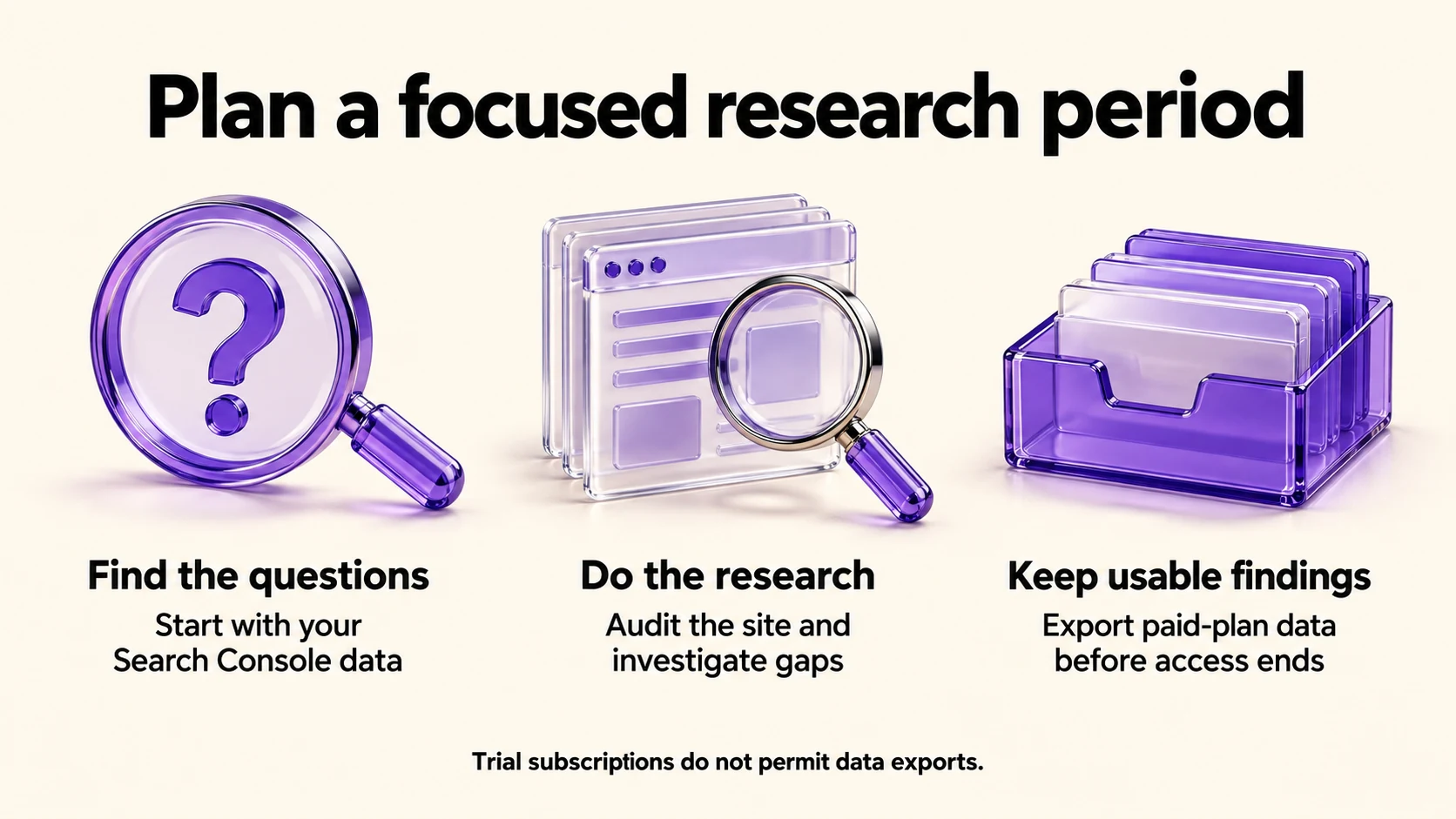
- Run Search Console weekly for four weeks and write down the five queries you actually want to win.
- Subscribe for one month at the monthly rate, deliberately, with those five queries in hand.
- Use the month for the one-off work: a site audit, a competitor gap analysis, and a keyword list for the next six months of articles.
- Export the needed data permitted by your paid plan before access ends, cancel if appropriate, and use the list for the next six months of publishing. Trial subscriptions do not permit data exports.
- Re-subscribe when the list runs out, or when the data says you are winning and want more.
This is a possible pattern for one-off research; sites needing continuous monitoring may require ongoing access. Our Semrush vs Ahrefs comparison covers which of the two suits that pattern better.
When the SEO plan is worth it
- You can reasonably attribute enough additional contribution after delivery costs to cover the subscription. One client covers a year only if that contribution exceeds the annual cost.
- You manage two or three sites, including a client’s, within the 5-website limit.
- You publish weekly and need a keyword pipeline rather than a one-off list.
- You are competing in a niche where knowing competitors’ new pages matters.
When it is not
- A brochure site that rarely changes.
- A business whose customers come from marketplaces, referrals or social.
- Any situation where the subscription would be the biggest line in your marketing budget.
- Curiosity. It is an expensive way to satisfy it.
Frequently asked questions
Is the SEO plan enough for one site?
Five websites and 500 daily tracked keywords may cover a small site’s volume, but check capabilities too. Pro+ adds historical SEO data, content optimization, keyword cannibalization analysis and multi-location/device tracking. Choose the lowest tier covering both required features and volume.
How much is annual billing?
The page shows $117.33 a month on annual billing against US$139 monthly, which implies approximately $1,408 versus $1,668 for twelve months. The annual figure is calculated from a rounded display; confirm the invoice total.
Are the AI search features included?
Basic AI search performance, sentiment and visibility reports are included. SEO has no dedicated prompt-tracking quota; Starter adds 50 daily tracked prompts, AI-ready Site Audit and per-domain AI brand performance. Higher tiers add features as well as limits.
Can I share a subscription with another freelancer?
Check the current terms before doing that; seat and sharing rules are set by Semrush, not by convenience.
Sources and method
Original research: September 21, 2026. Text revision: September 21, 2026. For this revision, the subscription guide was rechecked for feature differences. Prices and the USD terms basis are retained from the separate September 21 price review. Sources used across the original research and this revision: the pricing page linked above, Semrush’s subscription guide for detailed feature scope, and its terms for the USD basis. Rates are published figures, not currency conversions; calculated annual totals from rounded monthly equivalents are approximate. The decision routine is an editorial suggestion, not evidence of accuracy, traffic, rankings or client acquisition. Confirm required features and the invoice total before purchasing.
Read next