Semrush now sells AI-search visibility as part of its plans rather than as an add-on: the SEO plan at US$139 a month lists tracking performance in AI search, AI sentiment monitoring and AI visibility reports, and the Starter plan at $199 adds tracked prompts. For a one-person business the honest use is diagnosis, not a new channel to optimize. Track a handful of prompts, read them monthly, and change nothing on a single data point.
Original research dated September 21, 2026; text revised September 21, 2026. Claim-specific rechecks are identified in Sources and method. This article contains no affiliate links.
Who this is for
You run a small site, you have noticed fewer clicks from search, and you want to know whether AI assistants mention your business at all, and whether a tool is worth paying for to find out.
 Before you buyIs Semrush’s SEO Plan Worth It for One Site?Whether the Semrush SEO plan is worth it for one site, and free alternatives.See the plans →
Manual baseline: what you can check for free
Open the assistants your customers use and ask the questions they would ask: “best bookkeeper for photographers in Leeds”, “who does Webflow migrations”. Note whether you appear, who does, and what the answer says about you. Do it once a month and write it down. That is a small, honest baseline, and it costs nothing. A tool replaces the manual checking with scale and history, not with certainty.
What Semrush lists on each plan
All prices below are in USD. Semrush’s terms, section 5.1 define website dollar amounts as US dollars unless stated otherwise; checkout may designate another currency.
| Plan | Monthly | Annual, per month | Limits and AI features listed |
|---|---|---|---|
| SEO | US$139 | $117.33 | 5 websites, 500 keywords tracked daily; track performance in AI search, monitor AI sentiment, AI visibility reports; no dedicated prompt-tracking quota, AI-ready Site Audit or per-domain AI brand performance |
| Starter | $199 | $165.17 | 5 websites, 500 keywords; 50 prompts tracked daily, 1 domain for AI brand performance, 300 daily AI visibility reports, AI-ready Site Audit, MCP access |
| Pro+ | $299 | $248.17 | 15 websites, 1,500 keywords; 100 prompts tracked daily |
| Advanced | $549 | $455.67 | 40 websites, 5,000 keywords; 200 prompts tracked daily |
Source: Semrush pricing. Plan names and packaging here differ from the Pro, Guru and Business tiers many older articles describe, which is worth knowing if you are comparing reviews.
What “AI visibility” can and cannot tell you
- It measures a sample, not all AI use. Tracking prompts shows what assistants answered for those prompts, from the tool’s vantage point. It is not your traffic, and it is not every user’s answer.
- Answers vary by user and by session. Personalization, location and model updates all move results, so a single check is weak evidence.
- Sentiment is an interpretation. “Monitor AI sentiment” is a useful flag for a reputation problem, not a metric to report to a client as fact.
- Prompt limits matter. Match Starter’s 50 daily tracked prompts to your chosen questions and clients; adequacy depends on scope.
A monthly routine for one person
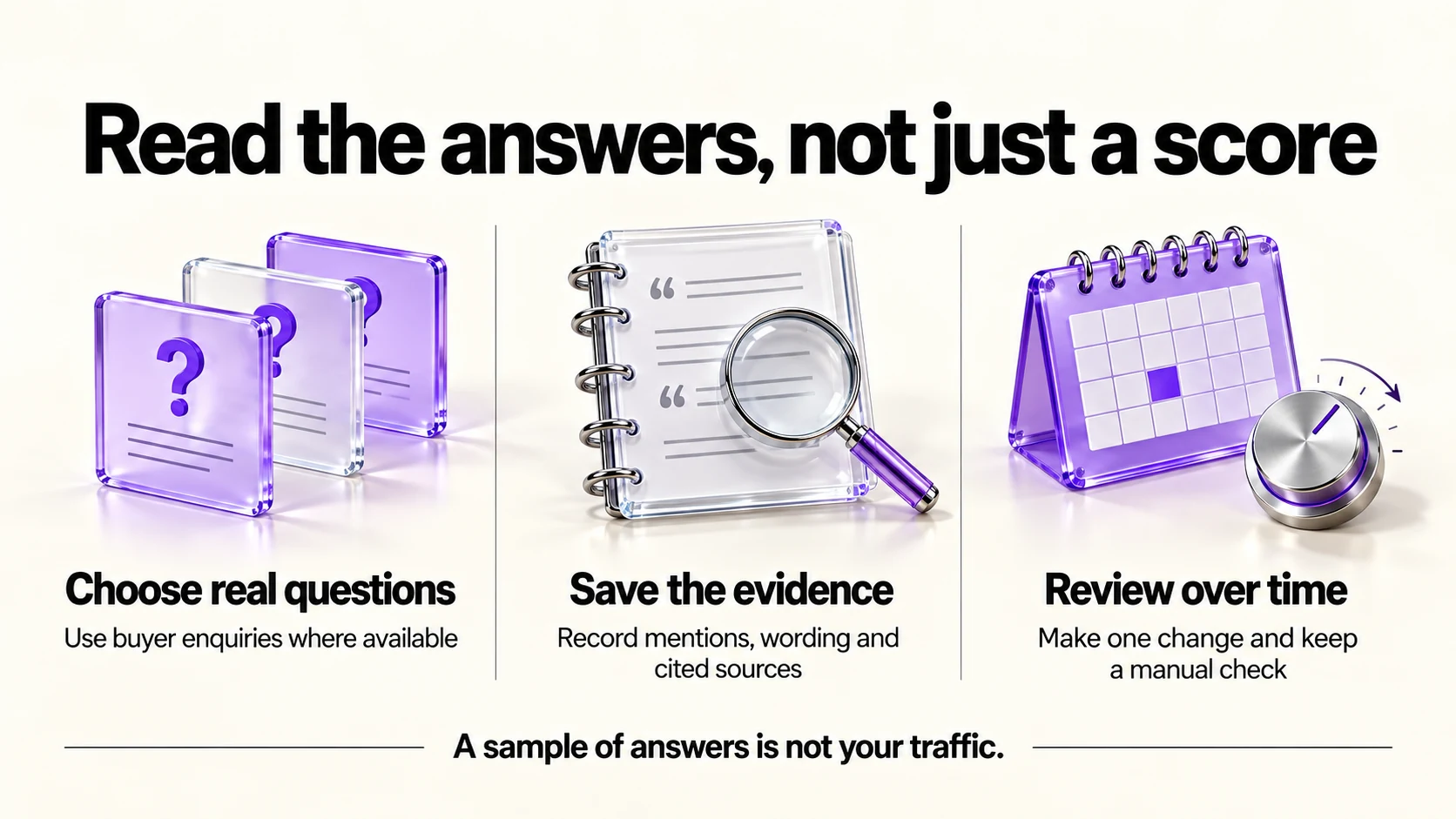
- Start with up to ten plausible buyer questions. Use actual enquiry wording where available; do not treat guesses as measured search demand. Include your category, your city if you are local, and two competitor-style questions.
- Record the answer, not just a score. Save whether you were mentioned, what was said, and which sources were cited.
- Look for the sources that get cited, then ask whether your site could plausibly be one of them: comparison pages, documentation, or a review site you are absent from.
- Change one thing, such as publishing the comparison page you are missing, and wait a month.
- Keep the manual spot check. Ask one prompt yourself each month, because reading the real answer keeps you honest about what the tool reports.
Is it worth $139 a month for one site?
Start with the questions the purchase would answer. The case for paying is when search is a main channel, you publish regularly, and you will act on what you learn. If your site is five pages and you publish twice a year, try the manual baseline before committing to recurring research costs. Our companion article on whether Semrush’s SEO plan is worth it for a single site works through that decision in more detail, and our Semrush vs Ahrefs comparison covers the alternative if you decide to pay.
What to do with what you find
- Missing entirely? Review whether your pages answer the question and whether cited sources describe you accurately. These are possible improvements, not a guaranteed route to inclusion.
- Mentioned with wrong details? Correct the sources you control first, including your own site, your profiles and any directory listings.
- A competitor named every time? Look at what they have published that you have not, rather than at the assistant.
- Nothing changes for months? Check the sample and methodology before drawing a conclusion; unchanged results do not prove that your work succeeded or failed.
Frequently asked questions
Does Semrush charge extra for AI search tracking?
Basic AI reporting is included on SEO. Dedicated prompt tracking starts on Starter in this comparison; it also adds AI-ready auditing and per-domain AI brand performance. These plans differ in features as well as quotas; see Semrush’s subscription guide.
How many prompts should I track?
Start with a small set tied to real buyer questions and expand only when another question adds useful coverage. Starter includes 50 tracked prompts daily; choosing ten is our suggested starting exercise, not a measured optimum.
Can I do this without a tool?
Yes, manually and at small scale. A tool buys history and repetition, which matters once you are acting on trends.
Will optimizing for AI search hurt normal SEO?
Clear, accurate pages can serve both audiences. Avoid changes made solely to chase one generated answer; assess conventional search performance separately.
Sources and method
Original research: September 21, 2026. Text revision: September 21, 2026. For this revision, the subscription guide was rechecked for AI feature scope. Prices and the USD terms basis are retained from the separate September 21 price review. Sources used across the original research and this revision: the pricing page linked above, Semrush’s subscription guide for detailed feature scope, and its terms for the USD basis. Rates are published figures, not currency conversions; calculated annual totals from rounded monthly equivalents are approximate. The decision routine is an editorial suggestion, not evidence of accuracy, traffic, rankings or client acquisition. Confirm required features and the invoice total before purchasing.
Read next