Repurposing works when you start from one published article and pull out claims you can already defend, not when you ask for “ten posts about my blog”. Give the assistant the full text, ask for the distinct ideas first, then write one post per idea in your own format. Every number and quote must trace back to the article, and you schedule the posts yourself.
Original research dated September 21, 2026; text revised September 21, 2026. Claim-specific rechecks are identified in Sources and method. This article contains no affiliate links.
Who this is for
You publish articles or newsletters, you know social posts should follow, and the posting stops whenever client work gets busy.
Manual baseline: why repurposing stalls
Repurposing involves re-reading, choosing an idea, adapting its format and selecting any supporting image. If it competes with client work, set a small timebox for the draft rather than assuming a fixed time per post. The method below separates idea selection from writing; it has not been timed against a manual workflow.
Step 1: extract ideas, not posts
Here is an article I published: {paste the full text}.

List the distinct ideas in it that could stand alone for a reader
who has not read the article. For each: the idea in one sentence,
the exact sentence or data point from the article that supports it,
and who it is useful for.
Do not write social posts yet. Do not add ideas that are not in
the article.
Review the idea list before generating posts. Open the supporting passage for each idea and reject any claim the source does not make.
Step 2: one post per idea, in your format
Write a {platform} post for idea {number}.
Format: {your structure, e.g. hook line, three short lines, one
question at the end}. Under {number} words.
Use only the supporting sentence from the article. No statistics,
no client names, no emoji unless I list them: {allowed emoji}.
End with: {your call to action or none}.
Try one idea and channel at a time, then compare the draft against the source. This is an editorial approach, not a tested claim that single-post generation outperforms a batch.
Step 3: check before scheduling
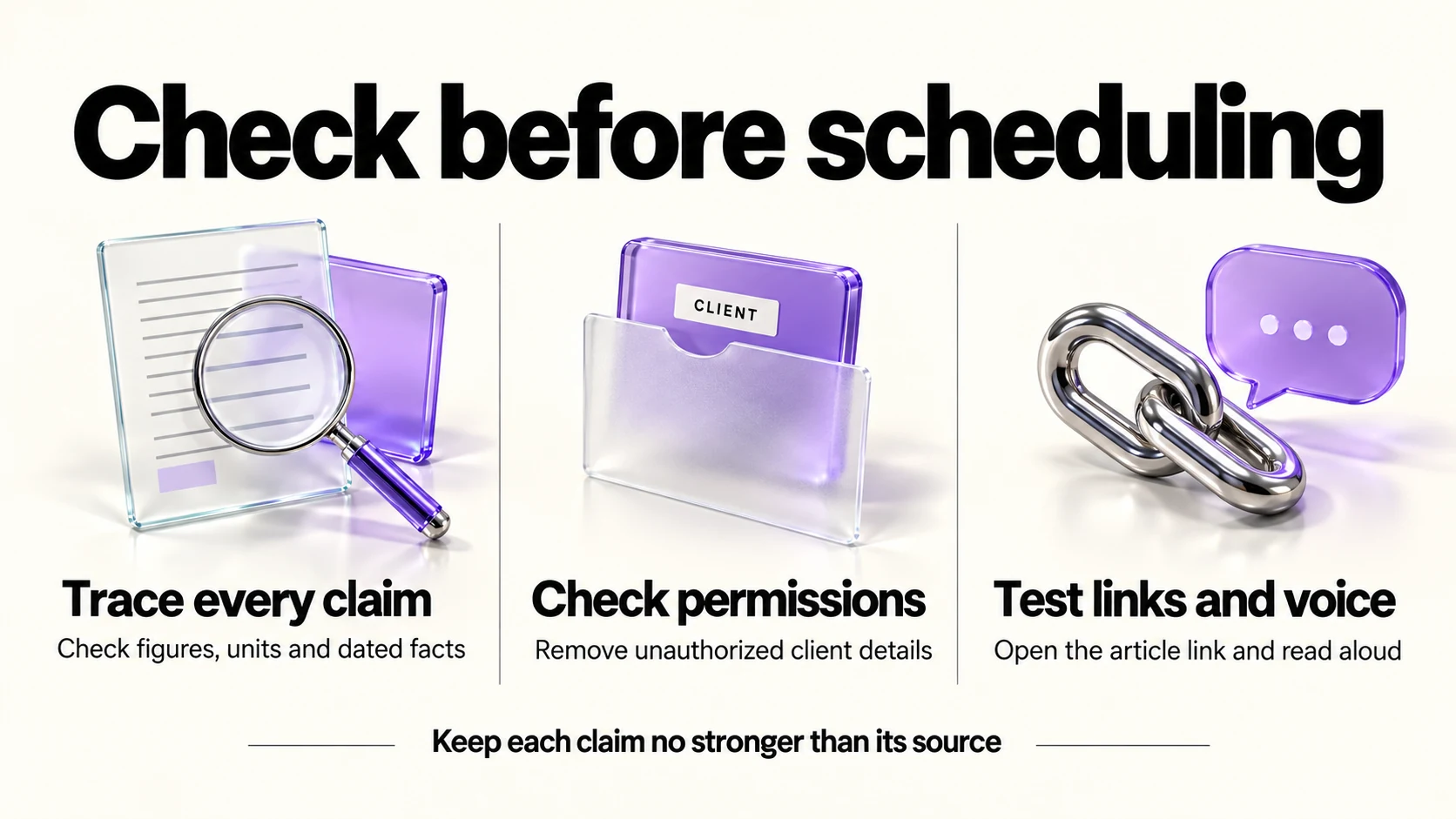
- Every figure appears in the article, in the same units, and remains supported by the original evidence. Recheck dated claims before repeating them.
- No claim is stronger than the article’s version of it.
- Client names and project details are removed before AI input unless their use is authorized; check the final draft again before publication.
- Links work and point to the article, not to a homepage.
- It sounds like you when read aloud.
What to make from one article
| Format | Source | Notes |
|---|---|---|
| Three short posts | Three separate ideas | Publish across two weeks, not one day |
| One longer post | The article’s conclusion | The only one that needs your voice most |
| One newsletter section | The practical steps | Link to the full article at the end |
| Five FAQ answers | Questions the article answers | Also useful on your site |
| One short video script | The single most useful tip | 60 seconds, one idea |
What not to repurpose
- Anything you have not verified since publishing. Prices and plan limits go stale; a post repeating an old price is a new error.
- Client stories without permission, even anonymized, if the client is identifiable.
- Screenshots containing other people’s data.
- Other people’s content without appropriate rights and attribution. Use your own material or content you have permission to adapt; do not imply someone else’s work or results are yours.
Scheduling without a second job
Batch the writing, then schedule. Buffer’s pricing page lists a Free plan with 3 channels and 10 posts per channel, and Essentials at $5 per channel/month equivalent, billed $60 yearly, with unlimited queued posts, with an AI Assistant listed across plans. Source: Buffer pricing. For one person with two channels, the free tier can hold a fortnight when the batch stays within ten queued posts per channel; our Later vs Buffer comparison covers the wider choice.
Before you paste your article
Your published article is public, so the sensitive part is anything unpublished you add. OpenAI documents the “Improve the model for everyone” setting under Settings, then Data Controls, with Temporary Chats deleted after 30 days and not used for training. Source: OpenAI Data Controls FAQ. Anthropic documents a “Model Improvement” setting, with Incognito chats excluded. Source: Is my data used for model training?. Google’s Gemini Apps privacy hub describes 18-month default retention, human review of a subset kept up to three years, and 72-hour retention with activity off. Source: Gemini Apps privacy hub
A repeatable weekly slot
- Friday, start with a 30-minute timebox: try steps 1 and 2 for the article you published that week.
- Check and edit, then schedule the following fortnight.
- Keep one slot empty for something timely.
- Once a month, look at which posts brought people to the article and write more like those.
Our weekly automation checkup covers holding a routine like this in place when client work gets loud.
Frequently asked questions
Will repurposed posts hurt my reach?
We make no claim about platform reach. Write for the reader of each platform rather than pasting the same text everywhere.
How many posts from one article?
Use as many distinct, supported ideas as the article contains. Three to five is a possible planning target, not a typical yield established by testing; stop before repetition or invention.
Should I disclose AI drafting?
Your call and your platform’s rules. The claims are yours either way.
Can I automate posting entirely?
You can schedule, but read each post before it goes out. An unchecked post is published in your name.
Sources and method
Original research: September 21, 2026. Text revision: September 21, 2026. For this revision, Buffer pricing was rechecked for billing basis and queue limits. Privacy statements are retained from the original September 21 research, not freshly verified for this correction. The extraction method, prompts, format table and checks are our editorial method. Paid Buffer rates here are annual-billing monthly equivalents.
Read next