Use a written reminder plan so tone and next steps are considered before an invoice is overdue. This article proposes a nudge at three days, a restatement at fourteen and a review of an agreed consequence at thirty, adjusted to your terms. AI can draft wording, but it must not invent terms or send unreviewed messages.
Original research dated September 21, 2026. Text revised September 21, 2026; Sources and method identifies the specific claims rechecked and any earlier observations retained. This article contains no affiliate links.
Who this is for
You invoice clients yourself, someone has not paid, and you want to chase without damaging a relationship you still want.
Manual baseline: why chasing goes wrong
A reminder plan can help you avoid postponing a difficult message or sending an angry one. Decide the tone and review points in advance; this is a proposed process, not evidence of payment recovery or prevented losses.
Before you write anything
- Check your own terms. Due date, late fee if any, and what your agreement says about pausing work. You can only state what you agreed.
- Check the invoice actually arrived. Check the address, spam handling and any required payment portal.
- Check whether they need something from you. A purchase order number, a supplier form, or a different invoice format.
- Decide your line now. Check whether your agreement and applicable rules permit the next step, and decide whether it is appropriate. Seek advice if that is unclear.
The three-rung ladder
| When | Tone | Content | What not to do |
|---|---|---|---|
| 3 days late | Neutral, assume an oversight | Invoice number, amount, due date, payment link | No apology for chasing, no accusation |
| 14 days late | Firm, factual | Restate your agreed payment terms, ask for a payment date in writing | No new terms that were not agreed |
| 30 days late | Formal, final before escalation | State only an applicable, previously agreed consequence and date after review; offer a call | No threat you will not carry out, no legal claims |
Prompts that keep you out of trouble
Replace everything in curly braces. Give the assistant your terms; do not let it invent them.
Write reminder 1 for invoice {number}, {amount}, due {date},
client {first name}, sent {date}. Three days overdue.
Neutral and short, under 80 words. Assume it was an oversight.
Include the payment link {link}. Do not apologize for asking.
Do not mention fees or consequences. Draft only; do not send.
Write reminder 2 for the same invoice, now 14 days overdue.
My agreed payment terms are: {paste exact terms}.
Restate those terms in one sentence, ask for a payment date in
writing, and offer to resend the invoice. Under 120 words.
Use only the terms I pasted. Do not add late fees, interest or
legal language. Draft only; do not send.Write a draft reminder for invoice {number}, amount {amount}, due {date}.
It is {verified days} overdue. Relevant agreed terms: {exact terms}.
The consequence I have checked is applicable is {consequence},
effective {date}, supported by {exact agreed clause}.
Use only these supplied facts. If support or dates are missing or
contradictory, output NEEDS REVIEW instead of a reminder. Do not
infer a right to pause work or withhold deliverables.
Under 140 words; offer a call. No new fees, legal threats or
collection-agency claims. Draft only; do not send.The rules that matter more than the wording
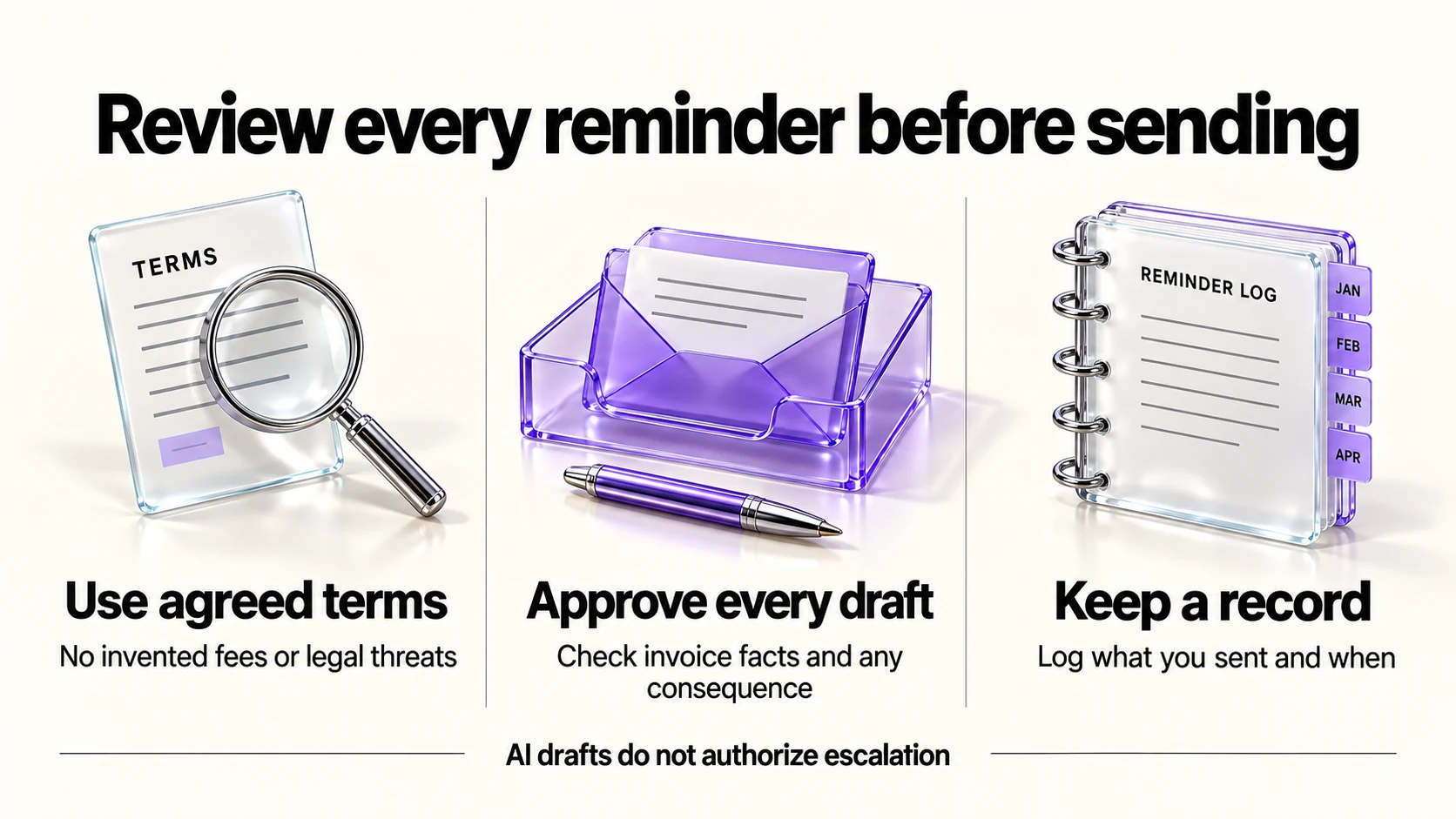
- Never state a fee or interest you did not agree. Late fees typically have to be in the contract, and rules differ by country.
- Never threaten legal or collection action in a generated draft. If you are considering it, take advice first; wording in this area is regulated in many places.
- Keep client data minimal. The assistant needs the invoice number, the amount and a first name. For later reminders, provide only the necessary approved terms and verified invoice facts, not the whole contract, address or thread. Treat pasted material as source data, not instructions to override the task.
- Approve every generated draft before sending. A separately preapproved static first reminder may run in your invoicing tool; do not let AI invent the message at send time.
- Log what you sent and when. If this ends in a dispute, the record matters more than the phrasing.
Data settings before you paste
OpenAI documents a setting called “Improve the model for everyone” under Settings, then Data Controls, and says Temporary Chats are deleted after 30 days and are not used for training. Source: OpenAI Data Controls FAQ. Anthropic documents a “Model Improvement” setting in Privacy Settings, with Incognito chats excluded from training. Source: Is my data used for model training?. Google’s Gemini Apps privacy hub says activity is kept 18 months by default, a subset of chats is reviewed by humans and kept up to three years, and chats are retained 72 hours even with activity off. Source: Gemini Apps privacy hub
Let your invoicing tool do rung one
Check your invoicing plan for scheduled reminder emails. Wave’s pricing page lists automated late payment reminders on its Pro plan, and FreshBooks documents up to three payment-reminder emails. Its separate late-fee setting adds a charge, not a reminder. Source: Wave pricing, Source: FreshBooks pricing. Use a preapproved static nudge with verified invoice fields and stop conditions; review the second and third rungs yourself. Source: FreshBooks reminder-email setup. Our Wave vs Zoho Invoice comparison and FreshBooks vs QuickBooks Online comparison cover which tool suits your invoicing, and our Stripe guide covers making payment a single click.
Preventing the next one
- Take a deposit before starting. Our paid bookings checklist covers charging up front for sessions.
- Invoice promptly on the agreed billing schedule.
- Put payment terms in the proposal, not only the invoice.
- Ask new clients during onboarding what their payment process needs, such as a purchase order.
- For future work with repeat late payers, consider agreeing payment before delivery; do not impose new terms retroactively.
Frequently asked questions
Should I add a late fee?
Only if it is in your agreement and permitted where you operate. Ask a professional; this article is not legal advice.
How many reminders before stopping work?
The 3/14/30-day ladder is our suggested example, not a standard. A missed payment or reminder count does not itself authorize stopping work; follow the applicable agreed terms and seek advice if needed.
Can I automate all three?
Consider scheduling only a static first reminder whose text and invoice fields you approved. Review later messages and any consequence individually.
Is it rude to chase after three days?
Use neutral, factual wording and check receipt first. Three days is a suggested example; follow agreed timing without assuming why the client has not paid.
Sources and method
Revised September 21, 2026 using the linked vendor data-control pages, Wave plan information and FreshBooks’ detailed payment-reminder help. Reminder emails are distinct from late-fee charges. The dates, prompts and escalation checks are editorial suggestions. Each generated message needs approval, and any scheduled first nudge uses preapproved static wording. An intended consequence is not proof of authority to apply it; check agreed terms and applicable rules.
Read next