Consider the new Toggl’s free plan for basic tracking: start a timer, assign the entry to a client project and review the total. Pay for Starter, US$12 per user billed monthly or US$108 per user paid annually (US$9 per month), when you want billable rates attached to time so reports come out in money instead of hours. If you already calculate rates in your invoicing tool, free is enough.
Original research dated September 20, 2026. Text revised September 21, 2026; Sources and method identifies the specific claims rechecked and any earlier observations retained. This article contains no affiliate links.
Which Toggl this comparison covers
This article compares the new Toggl for a US-based solo business considering a new subscription. It does not quote renewal prices for an existing Toggl Track contract. Toggl Track remains supported. An active paid Track organization may already receive the equivalent Toggl tier and seat count at no extra charge; check your entitlement before buying a second subscription. Features differ between the products. See the official Track-user FAQ.
Who this is for
You bill by the hour or need to know where your hours go, you work alone, and you are deciding whether a time tracker is worth paying for.
Manual baseline: the spreadsheet version
A spreadsheet baseline is: date, client, task, hours. It works until you forget to write an entry, or you have to reconstruct Tuesday on Friday. Reconstructing time from memory can omit or overstate work. A timer’s value is that it captures the hour when it happens, not that it produces prettier reports.
What the plans cost
| Plan | Billed monthly, per user | Paid annually, per user | What it adds for one person |
|---|---|---|---|
| Free | $0 | $0 | Manual and real-time timers, focus mode, calendar integrations, tasks, boards, task estimates |
| Starter | US$12/month | US$108/year (US$9/month equivalent) | Billable rates, timeline views, tags and milestones, capacity basics such as time off and holidays |
| Premium | US$24/month | US$192/year (US$16/month equivalent) | Labor costs and profitability reports, fixed-fee projects, timesheet approvals, Jira and Asana integrations |
| Enterprise | Contact sales | Not relevant to a one-person business | |
Source: new Toggl pricing. The public page describes Free as available for a limited number of users. Check the current allowance in your account; this comparison concerns one person.
The one feature that decides it: billable rates
Billable rates are listed from Starter up. With them, a tracked hour carries a rate, so a report calculates a billable amount; it does not prove the amount was invoiced or paid. Without them, use available time records and calculate amounts elsewhere; verify your plan’s export formats before depending on a CSV workflow. For a solo business that already raises invoices in another tool, multiplying elsewhere is one formula in a spreadsheet, which is why free is often enough. Our Stripe Payment Links vs invoicing guide and FreshBooks vs QuickBooks Online comparison cover where that step usually lives.
Four cases where paying is the right call
- Multiple rates. Different rates per client or per task type, where a spreadsheet formula becomes a source of errors.
- Retainers with a cap. You need to see, during the month, how much of a retainer is consumed in money, not hours.
- Disputed invoices. A client questions a line, and a rate-attached report answers it in one export.
- Planning capacity. Timeline views and time-off tracking matter if you schedule work weeks ahead.
Four cases where free is genuinely enough
- One rate for everything, applied at invoice time.
- Fixed-price projects where you track hours only to check profitability at the end.
- You track to understand your week, not to bill.
- Your invoicing tool already does rate calculation and you do not want a second source of truth.
Making tracking stick
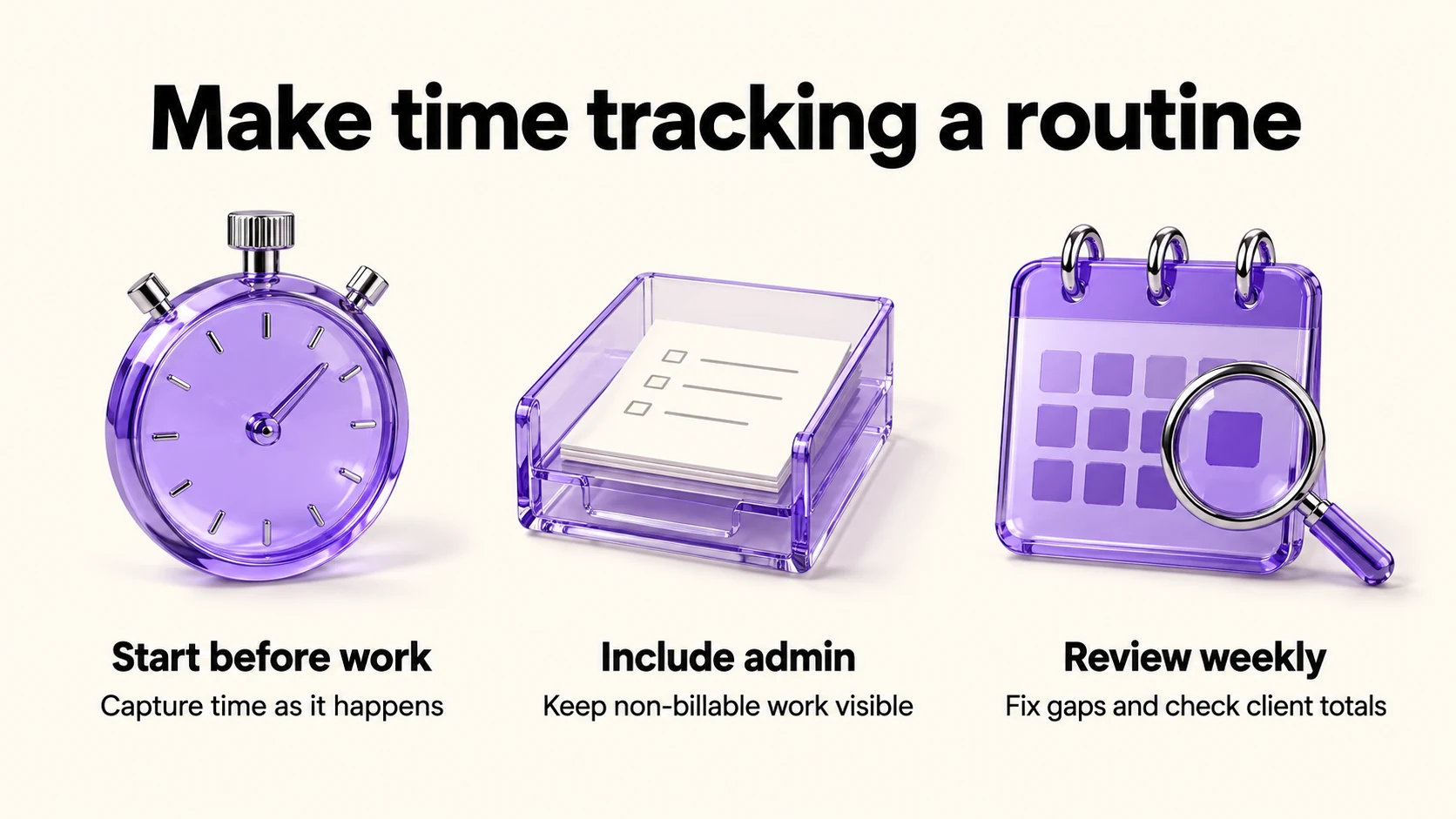
- One project per client, with tasks inside. Use a project structure you can maintain; separate deliverables when that helps billing or review.
- Start the timer before the work, not at the end of the day. Check reconstructed entries against your records rather than assuming they are accurate.
- Track admin too, under a non-billable project. Use your actual admin totals when assessing capacity and pricing; no weekly total is assumed here.
- Review on Friday, fix the gaps while you remember them, and export the client totals.
- Compare quoted versus actual on fixed-price work, and let the difference set your next quote.
The weekly review is also where you see whether a workflow needs fixing rather than timing more carefully; our weekly automation checkup covers that habit.
What a time tracker will not fix
- Underpricing. Accurate hours make it visible; they do not change your rate.
- Scope creep. Tracking the extra work is not the same as getting it approved and paid.
- Forgetting to start the timer. All plans have this failure mode.
- Tax or legal record-keeping requirements, which differ by country and are not covered here.
Frequently asked questions
Does this apply to my existing Toggl Track plan?
No. These are public new-Toggl prices. Check your existing Track subscription and included access before switching; this comparison does not establish your renewal price or migration entitlement.
Do I need Starter to invoice clients?
No. Starter adds billable rates inside Toggl; you can calculate amounts from your available time records and invoice separately. Verify export formats in your actual plan.
What does Premium add that Starter does not?
The page lists labor costs and profitability reports, fixed-fee projects, timesheet approvals, and Jira and Asana integrations.
Is annual billing worth it?
At the listed rates, twelve monthly Starter payments total US$144 versus US$108 paid annually, a US$36 difference. Premium totals US$288 versus US$192, a US$96 difference. These calculations assume unchanged public rates and exclude tax and offers. An annual commitment is worthwhile only if you expect to use it for the full term; do not infer refund rights from the monthly equivalent.
Sources and method
Pricing and product scope corrected September 21, 2026 against the current Toggl pricing destination, and the linked Track-user FAQ. Public monthly and annual prices concern new Toggl; existing Track billing was not verified. The free/paid distinction is documented; billable amounts are not cash receipts and remembered time is not assumed to be underbilled. The tracking routine and upgrade cases are suggestions to assess against your own records. Prices and billing terms can change.
Read next