Descript offers transcript-based audio and video editing. Hobbyist is US$24 per person/month billed monthly, or US$16 per person/month equivalent on annual billing, with ten monthly media hours and 400 AI credits. Choose by required export features and actual source-media and AI usage. The free video watermark may matter for your work; it does not make every free audio or video use unsuitable.
Original research dated September 21, 2026; text revised September 21, 2026. Claim-specific rechecks are identified in Sources and method. This article contains no affiliate links.
Who this is for
You record a podcast, client interviews or short videos alone, and editing is the part that makes you consider stopping.
Manual baseline: editing by waveform
Conventional editing means scrubbing a timeline, listening for the bad take, and cutting by ear. For a conversation, this can involve finding filler words, false starts and unwanted background sounds; the time depends on the material and editor. Transcript-based editing turns that into deleting text, which offers another way to locate cuts.
What the plans include
| Plan | Price | Media hours a month | AI credits | Export |
|---|---|---|---|---|
| Free | $0 | 60 minutes a month | 100, one-time | Video exports watermarked |
| Hobbyist | $24/person/month billed monthly; $16/person/month equivalent billed annually | 10 | 400 a month | 1080p, watermark-free |
| Creator | $35/person/month billed monthly; $24/person/month equivalent billed annually | 30 | 800 a month | 4K, watermark-free |
| Business | $65/person/month billed monthly; $50/person/month equivalent billed annually | 40 | 1,500 a month | 4K, watermark-free |
Source: Descript pricing. Named AI features include Studio Sound, Remove Filler Words, “Underlord, our AI video co-editor”, AI Speech voice clones, green screen, eye contact and automatic multicam.
Media hours are the number to plan around
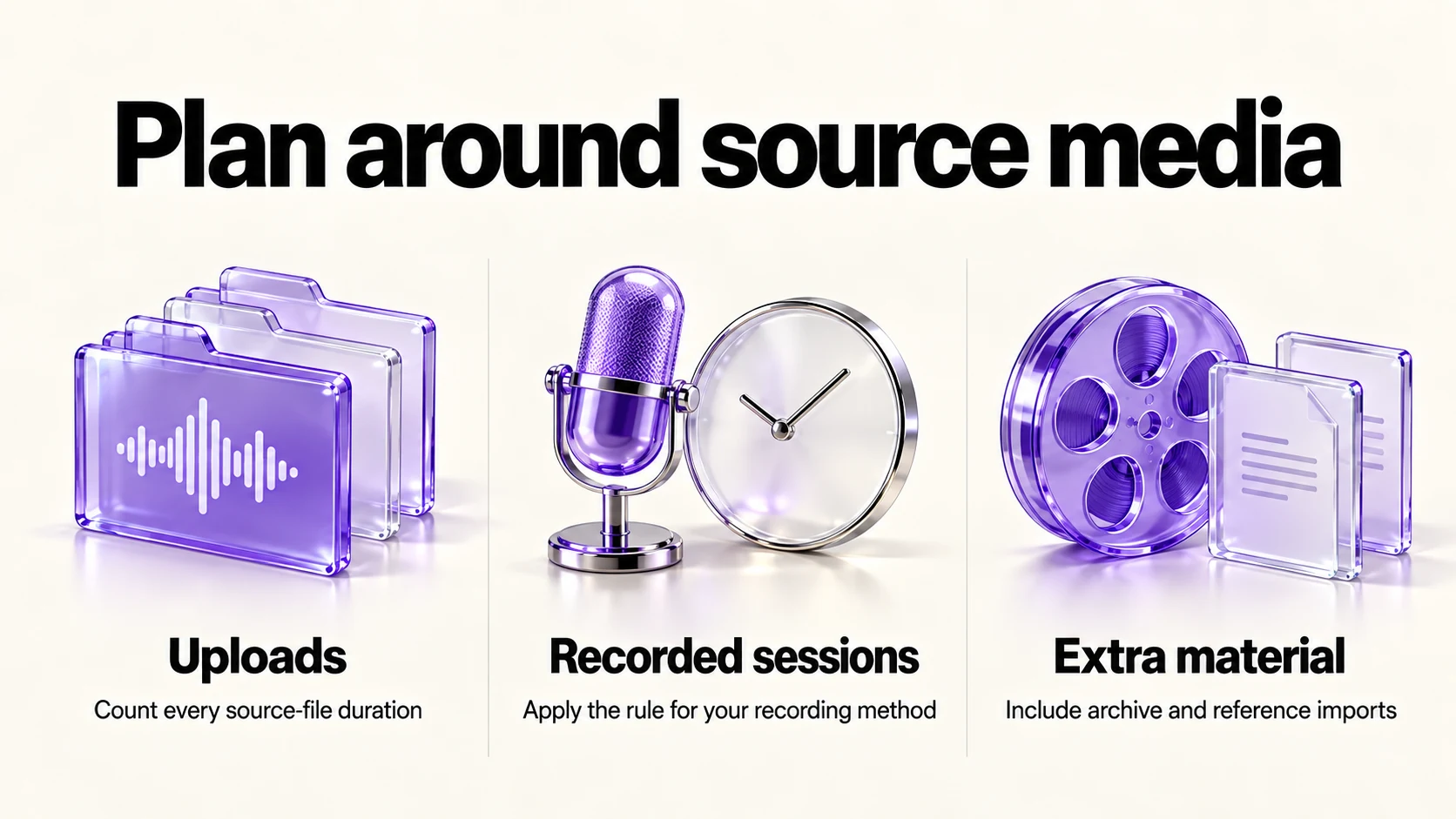
Media hours concern source material, not finished running time. Four weekly episodes with two separately uploaded 45-minute files each total six hours; five such episodes total 7.5 hours, before other uploads. Rooms recordings are counted by session length rather than participant, so do not multiply a Rooms session by its speaker count. Descript usage documentation explains media and AI-credit consumption.
- Count uploaded source durations and recorded sessions, applying the correct rule for your recording method.
- Add anything you import for reference, such as archive audio.
- Compare that with 10 hours on Hobbyist and 30 on Creator.
- If close to a limit, compare a higher plan with any eligible top-ups using the current rates; do not assume upgrading is always cheaper.
Which AI features earn their credits
- Remove Filler Words. A candidate for reducing repetitive edits, but removing hesitations can change tone or meaning. Still listen to the result, because aggressive removal can clip breaths and make speech sound rushed.
- Studio Sound. Useful when you record in an untreated room. Compare before and after on headphones; processing can introduce artefacts on some voices.
- Underlord. An AI co-editor for structural suggestions. Treat suggested cuts as proposals and watch the result end to end.
- AI Speech voice clones. Powerful and the highest-risk feature in the list. For this suggested workflow, limit synthesis to your own voice and disclose it. Do not clone a guest or invent their statements; consent to recording alone is not consent to voice synthesis.
The ethics line for a solo creator
- Do not alter meaning. Cutting a pause is editing; splicing a sentence into a different answer is misrepresentation.
- Get consent for guests, in writing, covering recording, editing and any AI processing of their voice.
- Disclose synthetic speech where you use it, and check the applicable platform rules.
- Keep the raw recording. If a guest disputes an edit, the original is your evidence.
- Check local rules on recording, which differ by country and by state.
Where it fits your wider setup
Transcripts are useful beyond the edit: they are the source for show notes, blog posts and social clips. Our guide to repurposing one article into social posts applies equally to an episode transcript, and our Gemini meeting notes guide covers the consent questions when recording conversations for work rather than publication.
When not to buy it
- You publish occasionally and the free plan’s watermark does not matter, for example for internal videos.
- Your editing is visual rather than spoken, where a transcript-first editor is the wrong shape.
- You already have an editing workflow you are fast in; the migration cost is real.
- You need collaboration features that only appear on higher plans, and you are a team of one.
Frequently asked questions
Is the free plan usable?
It provides 60 media minutes monthly and 100 one-time AI credits. Video exports carry a watermark, so assess the export you need rather than treating Free as unsuitable for every publishing use.
What is an AI credit used for?
AI tools consume credits according to the action and, for some generation features, usage. Descript’s usage documentation above provides action costs. Check the selected tool and current allowance before heavy use.
Which plan for a weekly podcast?
Estimate source usage first. Two separately uploaded 45-minute files for each of four episodes total six hours; five episodes total 7.5. Rooms has a different counting rule, and extra media adds usage. These examples do not by themselves require more than Hobbyist’s ten hours.
Can I clone a guest’s voice?
This article’s suggested workflow excludes guest voice cloning. Any separate use would require explicit authorization for synthesis and compliance with the tool’s current voice-verification and use rules; ordinary recording consent is not sufficient.
Sources and method
Original research: September 21, 2026. Text revision: September 21, 2026. For this revision, Descript’s pricing, media/AI usage and payment documentation were rechecked. The monthly/annual amount mapping also uses the separate September 21 price review. Sources used across the original research and this revision: Descript pricing and usage guidance linked above, plus payment documentation for the USD basis. Published monthly/annual amounts are per person. Media examples are arithmetic under stated import assumptions. Verify consent and current platform requirements before any synthetic speech.
Read next