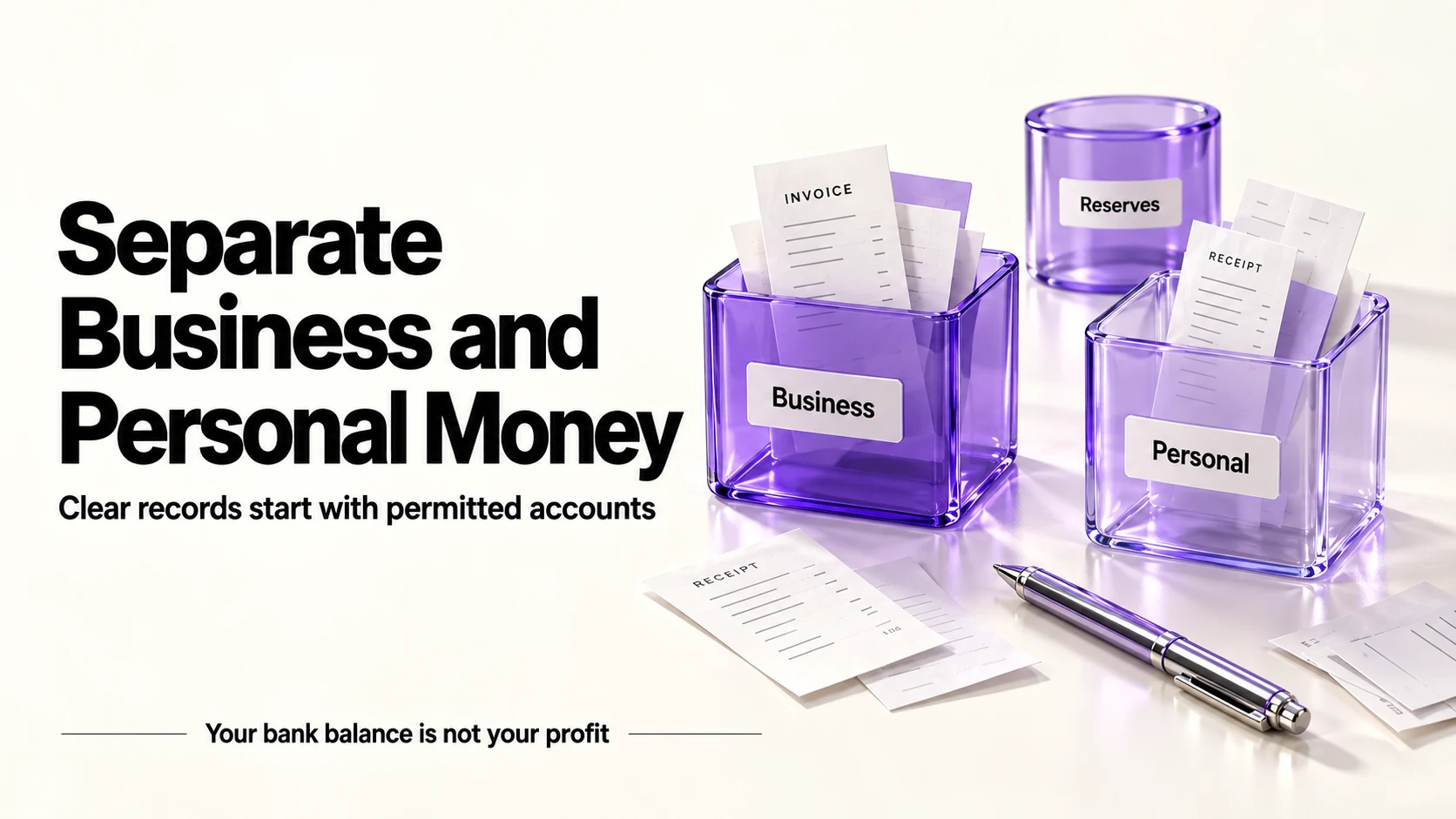
Separating business and personal transactions can make records easier to organize, but account choice must fit your bank’s terms and business structure. Use permitted accounts and payment routes, retain supporting documents, and reconcile regularly. Plan transfers around obligations and available cash rather than treating the bank balance as profit. Tax, legal and owner-payment requirements depend on your jurisdiction and structure.
Original research dated September 21, 2026; text revised September 21, 2026. Claim-specific rechecks are identified in Sources and method. This article contains no affiliate links.
Who this is for
You are a freelancer or sole trader whose business income lands in the same account as your rent, and every month-end is an archaeology exercise.
Manual baseline: the mixed account
One account means every bookkeeping session starts with sorting: which coffee was a client meeting, which subscription is business, which transfer was a client payment and which was a refund from a shop. It is slow, it is error-prone, and it hides the number that matters, which is what the business actually earns. A separate account is a practical organizing step only if its terms permit your business activity and it fits your legal structure.
The four-part setup
| Part | What it is for | Rule |
|---|---|---|
| Business account | All income in, all business costs out | Avoid personal purchases; record owner contributions and withdrawals separately |
| Business card | Subscriptions and business purchases | Use a permitted dedicated card; reconcile statements with receipts and invoices |
| Set-aside account | Tax and larger irregular costs | Review required reserves and due dates; any percentage is an estimate to update |
| Personal account | Your life | Use properly recorded owner payments suited to your structure and cash obligations |
Setting it up in an afternoon
An afternoon is a planning timebox, not a promise: provider approval and account changes may take longer.
- Open a business account in whatever form your country allows for your structure. Do not use a personal account for business unless the bank’s terms and your legal structure allow it; confirm suitability before opening or repurposing one.
- Move your income routes. Update your invoice template, your payment links and your client records so new payments arrive in the new account. Our Stripe Payment Links vs invoicing guide covers the payment side.
- Move your outgoings. List every business subscription and switch each one to the business card. Our weekly automation checkup is a good moment to catch the ones you forgot.
- Set the monthly transfer. A regular schedule can help planning, but review the amount against tax estimates, bills, reserves and the permitted owner-payment method.
- Connect your accounting tool to the business account only. Our FreshBooks vs QuickBooks Online comparison and Wave vs Zoho Invoice comparison cover the options at different price points.
The monthly routine that keeps it clean
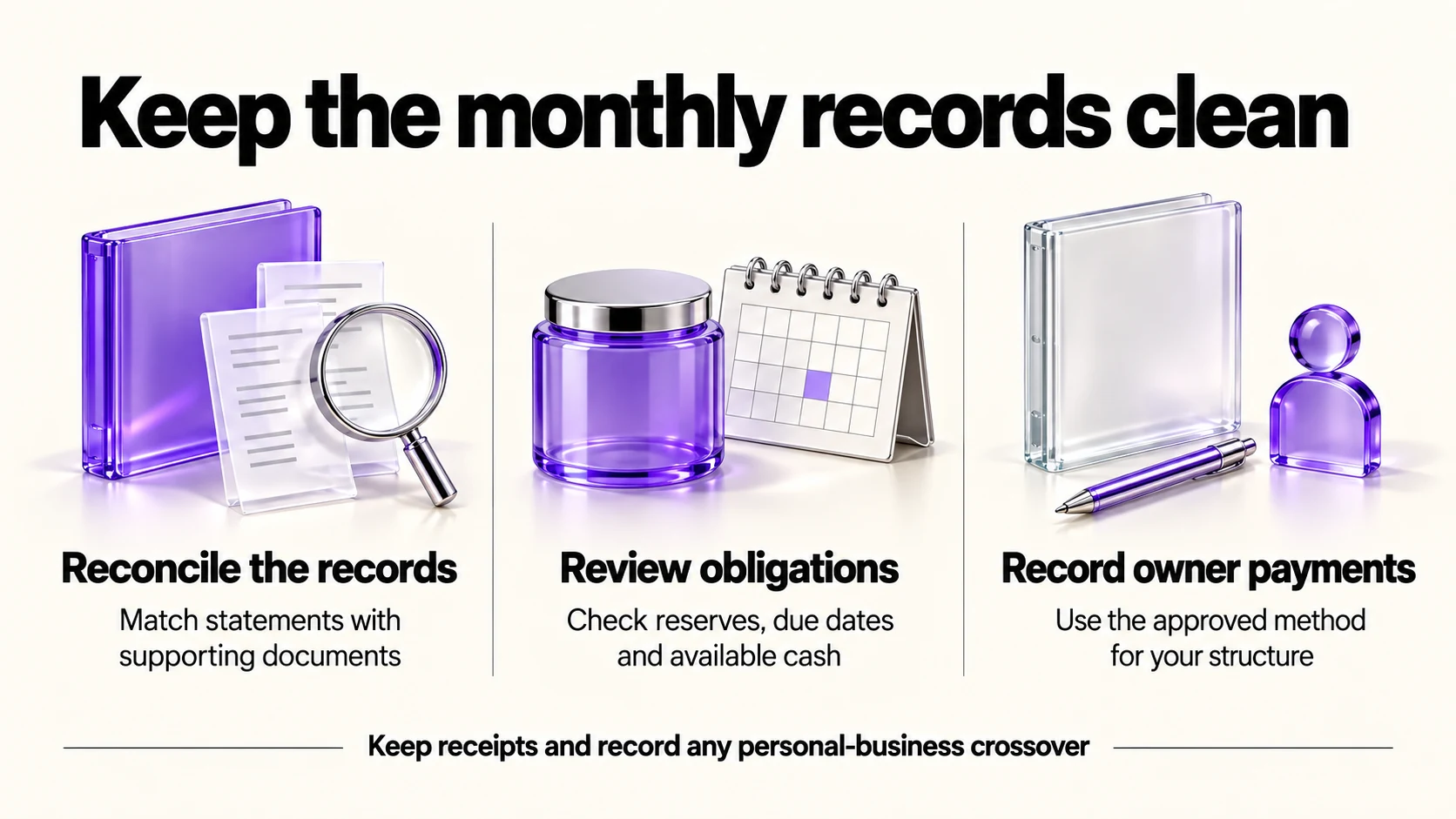
- Reconcile bank and card statements with invoices, receipts and other supporting records.
- Review reserves against expected obligations and payment dates before deciding on owner payments.
- Make and record the approved owner payment only after checking available cash and obligations.
- Keep supporting receipts and invoices, including amount, payee, date and business purpose; statements alone may not substantiate the transaction.
- Note any crossover, such as a business cost paid personally by accident, and record it the way your accountant asks rather than ignoring it.
What separation does and does not change
- Does: can reduce mixing of personal and business transactions. Complete, reconciled records are still needed; no time saving was measured here.
- Does: helps you see business cash separately. The balance is not profit or unrestricted cash: unpaid bills, taxes, reserves and timing still matter.
- Does not: create legal separation between you and the business. For sole traders in many countries, you and the business are the same legal person regardless of how many accounts you have.
- Does not: decide what is deductible, how much to set aside, or when tax is due. Those are professional questions with country-specific answers.
Common mistakes
- Dipping into the business account for personal spending “just this once”, which is how the habit dies.
- Paying yourself whatever is left. Unplanned withdrawals can complicate forecasting. A regular amount is one option, but variable income or obligations may require adjustments; record them properly.
- Setting aside nothing because the bill is months away.
- Mixing currencies and payment processors without a rule about where settlement lands.
- Waiting for the perfect setup. Choose a permitted account while getting any necessary structure advice; speed is not a reason to ignore bank terms.
Questions for your accountant
Take these to a professional in your country rather than to a search engine:
- What business structure suits my income level and risk, and when should I change it?
- What percentage should I set aside, and when are payments due?
- Which costs are deductible for my kind of work, and what records do you need?
- How should I treat a cost that is partly personal, such as a phone or a home office?
- What should I do about the mixed transactions from before I separated the accounts?
Frequently asked questions
Do I need a business bank account as a sole trader?
Requirements vary by country and by bank terms. Ask your accountant and read your bank’s terms; many personal accounts prohibit business use.
How much should I set aside for tax?
We do not give a number, because it depends on your country, income and structure. Ask a professional and set the percentage from their answer.
Is a second personal account enough to start?
Only if your bank permits the business use and the account is appropriate for your legal structure. Confirm both first; a second personal account is not a universal alternative to a business account.
What about business credit cards?
A dedicated card can help organize purchases only if its terms permit the intended business use. Keep supporting records as well as statements. Borrowing decisions are outside this guide.
Sources and method
Original research: September 21, 2026. Text revision: September 21, 2026. For this revision, the linked SBA and IRS guidance was checked as US-specific evidence. No reader’s account terms or tax position were assessed. Sources used across the original research and this revision: US SBA business-account guidance and IRS supporting-record guidance as US examples, not worldwide rules. The account template and review routine are editorial suggestions, not individualized financial advice. Bank eligibility, tax reserves, owner payments and record retention require jurisdiction-, entity- and provider-specific confirmation.
Read next